The mismatch between the skills taught in vocational education and training (VET) institutions and those actually required by the labour market is one of the most pressing challenges facing Europe’s industrial fabric. To address this need, TECH-BRIDGE VET was launched — an ambitious project co-funded by the European Erasmus+ programme.
The project is supported by a strategic partnership bringing together five European countries (Italy, Spain, Slovakia, Greece and Belgium), enabling the exchange of high-level international best practices, including the Spanish and Slovak dual training models. Thanks to this transnational synergy, TECH-BRIDGE VET does not aim to provide merely a local response. Instead, it seeks to develop a scalable and transferable model that can be applied in the future to other sectors and countries.
At present, the project focuses specifically on small and medium-sized enterprises (SMEs) in the mechanical sector, with the objective of addressing the shortage of two professional profiles that are currently extremely difficult to find: maintenance technicians and CNC machine operators.
Why Focus Groups?
Before proposing solutions, the project chose to listen to the key stakeholders. In this context, international focus groups played a central role in the preliminary research phase.
These joint working sessions, involving teachers, school coordinators and company representatives, aimed to assess the current state of cooperation between schools and enterprises, identifying both critical issues and areas for improvement. These field research activities were essential in understanding the real needs of both worlds and collecting the data necessary to model and design the future Tech-Bridge Academy and its digital platform.
The Barriers Identified: Why Is Cooperation So Difficult?
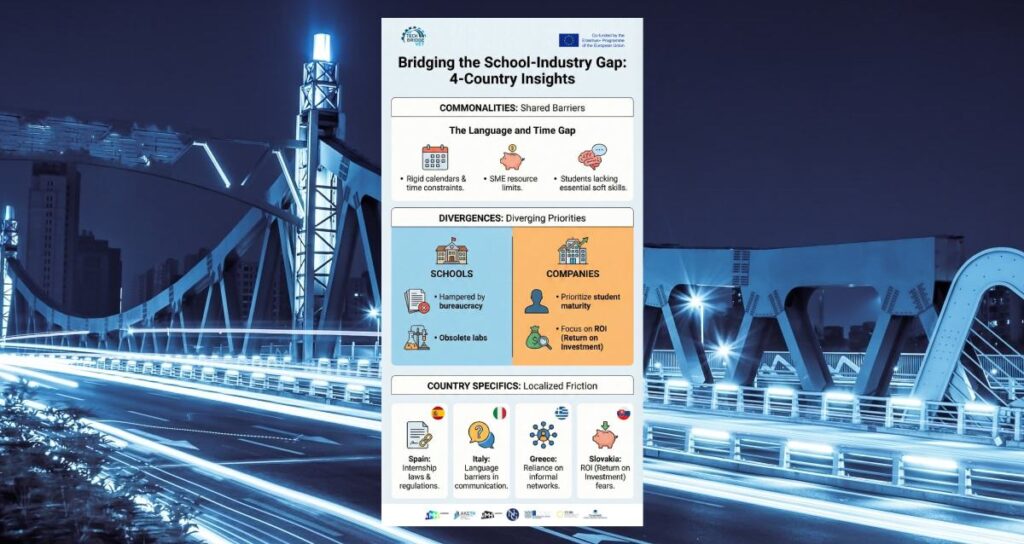
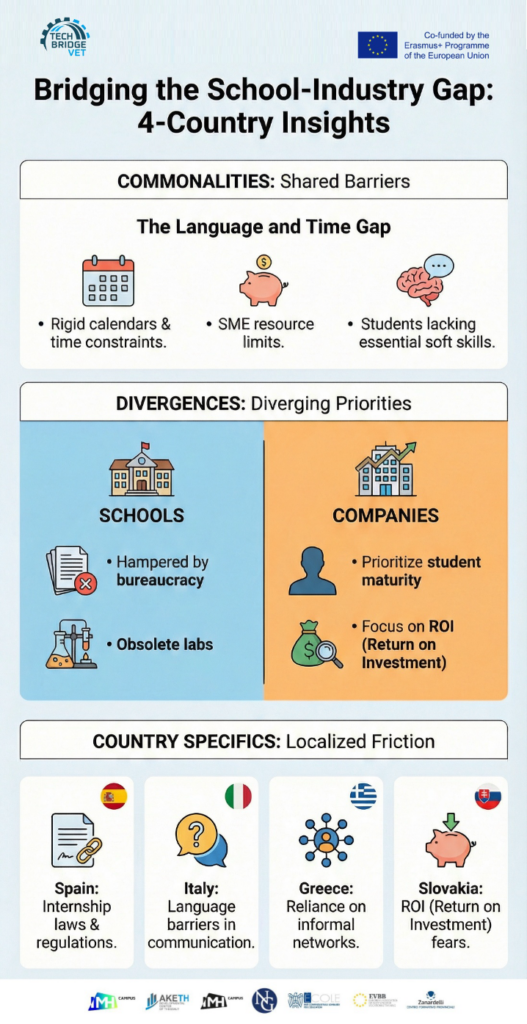
Direct discussions within the focus groups revealed that, despite a shared willingness to collaborate, schools and companies face systemic barriers.
First, there is a lack of common language and shared tools. Schools think in terms of curricula and learning outcomes, while companies focus on production tasks and operational requirements. A shared framework for co-designing training pathways is often missing.
Second, cooperation remains too fragmented. The success of internships and partnerships frequently depends on the individual initiative of a single teacher or entrepreneur. A clear need emerged to move towards a systemic approach rather than relying on isolated efforts.
Third, SMEs often face resource constraints. Small companies frequently lack the internal structures, trained mentors, or dedicated staff necessary to manage the continuous integration of young trainees effectively.
The Solutions: The Tech-Bridge Academy and Pilot Actions
To overcome these obstacles, TECH-BRIDGE VET goes beyond theoretical reflection and proposes concrete operational tools and pilot initiatives.
● The Tech-Bridge Academy and Digital Platform: the project will create an open-source virtual ecosystem serving as a genuine collaboration hub. This platform will enable schools and companies to communicate in real time, share educational materials, and co-design or update training curricula together in response to evolving market demands.
● “Train the Trainer” Programme: to ensure the effective use of the platform, professionals (“ambassadors”) will be trained to promote a culture of cooperation and to support schools and companies in adopting and using these new digital tools.
● Pilot Implementation: the newly developed curricula for maintenance technicians and CNC operators will be tested through two concrete pilot actions:
- A Summer School for 60 young participants (graduates or final-year students), aimed at facilitating their transition into the labour market with updated technical skills.
- A Lifelong Learning School dedicated to the reskilling of 75 adult workers already employed in companies, helping them respond to the challenges of digital and technological transformation.
Conclusion
Addressing the skills gap does not mean asking schools and companies to work in isolation. It means enabling them to join forces intelligently.
By creating a flexible, shared and European support architecture, TECH-BRIDGE VET aims to transform fragmented initiatives into a true training ecosystem — restoring attractiveness to technical education and ensuring that SMEs have the competences they need to face the future.