The European manufacturing sector is currently facing a major challenge: finding qualified technical professionals whose skills match the real needs of industry. While companies are rapidly evolving through digitalisation, automation and advanced manufacturing processes, vocational education and training (VET) systems are struggling to adapt at the same pace.
This challenge is especially significant for small and medium-sized enterprises (SMEs), which represent the backbone of the European industrial ecosystem. Many SMEs report increasing difficulties in recruiting technicians with both the technical competences and the professional attitudes required in modern industrial environments.
In this context, the Erasmus+ project TECH-BRIDGE VET aims to strengthen cooperation between vocational education providers and companies in order to reduce the skills mismatch in the mechanical and advanced manufacturing sector.
As part of the project activities, IMH Campus organised a series of Focus Groups in Spain involving:
- VET school coordinators and Dual VET tutors
- SMEs from the advanced manufacturing and industrial maintenance sector
- Experts involved in vocational training and industry collaboration
The objective was clear: to better understand the barriers, opportunities and success factors that shape cooperation between VET centres and companies.
The discussions generated valuable insights that may help improve Dual VET systems not only in Spain, but across Europe.
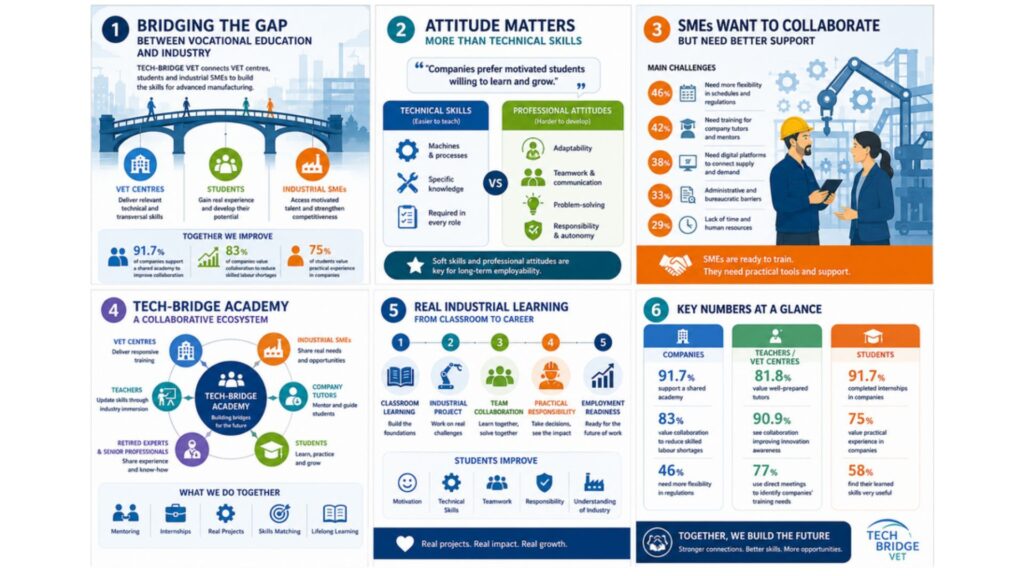
Attitude Matters More Than Technical Skills
One of the strongest conclusions emerging from both VET providers and companies was that technical skills alone are not enough.
Many companies highlighted that they prefer students with motivation, willingness to learn and a proactive attitude over technically strong candidates lacking commitment or responsibility.
According to several SMEs participating in the Focus Groups, employability increasingly depends on transversal competences such as:
- adaptability
- teamwork
- communication
- autonomy
- responsibility
- problem-solving
Companies repeatedly emphasised that these attitudes are often more difficult to teach than technical knowledge itself.
This finding reinforces the need for vocational education systems to place greater emphasis on personal development and professional behaviour alongside technical training.
SMEs Need Better Support to Train Students
Another important conclusion concerns the challenges faced by SMEs when hosting Dual VET students.
Many companies explained that they lack:
- time
- human resources
- pedagogical training
- administrative support to properly mentor students during workplace learning periods.
Both companies and VET centres agreed that company tutors play a fundamental role in the success of Dual VET programmes. However, many industrial instructors have strong technical expertise but little preparation in educational methodologies, mentoring or competence assessment.
Participants therefore stressed the importance of:
- developing training programmes for company tutors
- improving coordination between school and company mentors
- simplifying administrative procedures
- creating clearer collaboration frameworks
Strengthening the role of company tutors was identified as a key priority for improving the quality of cooperation.
Flexibility Is Essential for Effective Dual VET
The Focus Groups also revealed tensions between rigid academic calendars and the operational realities of SMEs.
Many companies stated that current Dual VET regulations are often too inflexible, particularly regarding:
- mandatory placements during the first year
- fixed schedules
- bureaucratic requirements
- limited adaptation to production cycles
This situation can be especially challenging for smaller companies with limited capacity to absorb students under strict predefined conditions.
At the same time, participants recognised that well-designed Dual VET experiences can become highly effective recruitment and talent-development tools.
Several companies explained that intensive second-year placements work particularly well because students arrive with higher maturity, better technical preparation and clearer professional motivation.
The discussions highlighted the need for more flexible and collaborative models capable of adapting to the diversity of industrial contexts.
Real Industrial Projects Create Meaningful Learning
Another major conclusion was the importance of learning through real industrial challenges rather than purely simulated exercises.
Both companies and VET providers agreed that students develop stronger technical and professional competences when they work on authentic industrial tasks involving real responsibility and real impact.
One of the examples discussed during the Focus Groups was the participation of students in industrial projects involving machine assembly and practical manufacturing challenges. These experiences significantly increased:
- student motivation
- technical learning
- teamwork
- responsibility
- understanding of industrial processes
Participants highlighted that project-based learning methodologies connected to real industrial environments are among the most effective strategies for reducing the skills mismatch.
Teachers and Industry Professionals Must Learn Together
The Focus Groups also emphasised the importance of creating stronger bridges between teachers and industrial professionals.
Participants considered that VET teachers who regularly spend time in companies gain:
- updated technical knowledge
- understanding of current industrial processes
- awareness of emerging technologies
- better capacity to contextualise classroom learning
At the same time, companies recognised the value of involving industry professionals directly in educational activities through:
- guest lectures
- mentoring
- collaborative projects
- technical workshops
- participation in student assessment
Another particularly interesting idea emerging from the discussions was the potential role of retired professionals and senior experts in transferring industrial know-how to younger generations.
Participants agreed that preserving and sharing this accumulated experience could become a valuable resource for vocational education systems.
Towards a Collaborative Ecosystem: The Role of TECH-BRIDGE Academy
One of the long-term ambitions of the TECH-BRIDGE VET project is the creation of the “TECH-BRIDGE Academy”, conceived as a collaborative ecosystem connecting VET centres, SMEs and other stakeholders.
The future platform aims to support:
- continuous communication between schools and companies
- management of internships and job opportunities
- competence matching
- tutor training
- collaborative industrial projects
- lifelong learning pathways
- curriculum feedback mechanisms
Rather than being a simple digital platform, the Academy is envisioned as a strategic tool for building sustainable cooperation between education and industry.
The strong interest expressed by both VET providers and companies during the Focus Groups demonstrates that there is a real demand for this type of collaborative structure.
Building Bridges for the Future
The conclusions of the Spanish Focus Groups clearly show that reducing the skills mismatch in advanced manufacturing requires much more than curriculum updates alone.
It requires:
- trust between schools and companies
- continuous dialogue
- flexible cooperation models
- stronger mentoring systems
- real industrial learning experiences
- and a shared commitment to developing future talent
The future of vocational education cannot be built exclusively in classrooms, nor exclusively in factories.
It must be built together.
Through initiatives such as TECH-BRIDGE VET, European VET systems and industrial SMEs have an opportunity to create stronger connections, develop more relevant skills and prepare the next generation of professionals for the challenges of advanced manufacturing.